

Will Artificial Intelligence Replace Traders?
Artificial Intelligence, as technological advances continue to reshape our world one question predominates: Will artificial intelligence replace traders?

Good afternoon traders
Your weekly FX talk where we delve into the fascinating world of foreign exchange and explore the strategies that drive success in the global financial markets. I'm thrilled to have you join us for another thought-provoking discussion.
So buckle up and get ready to expand your knowledge and refine your trading approach, as we unravel the secrets of Artificial Intelligence in Finance
Without further ado… Let’s dive in!
Artificial Intelligence, as technological advances continue to reshape our world one question predominates: Will artificial intelligence replace traders?
In the next few minutes of you reading this we’ll dive into the nuances of this captivating debate.
The rise of artificial intelligence has brought major transformations to many sectors including finance, sophisticated algorithms, machine learning and natural language processing have enabled AI systems to analyse huge amount of financial data in the blink of an eye.
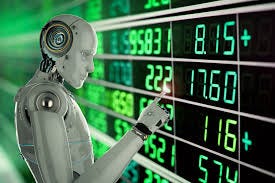
Automated high frequency trading is a striking example. However, it is important to not that artificial intelligence does not necessarily replace traders, but rather assits them in their decision making. Artificial intelligence offers traders an undeniable advantage by providing them with real time information, predictive analysis and models of market behaviour.
With this information, traders can make more informed and responsive decisions. AI can also automate certain repetitive and time consuming tasks, freeing up time to focus on more complex strategies and risk management. However, finance is also deeply influenced by emotional, psychological and contextual factors. Human traders have the ability to integrate information based not only on data, but also on geopolitical events, economic news and other complex variables. Human decision are often the results of intuition and a global understanding of the market, which can be difficult for an AI to replicate.
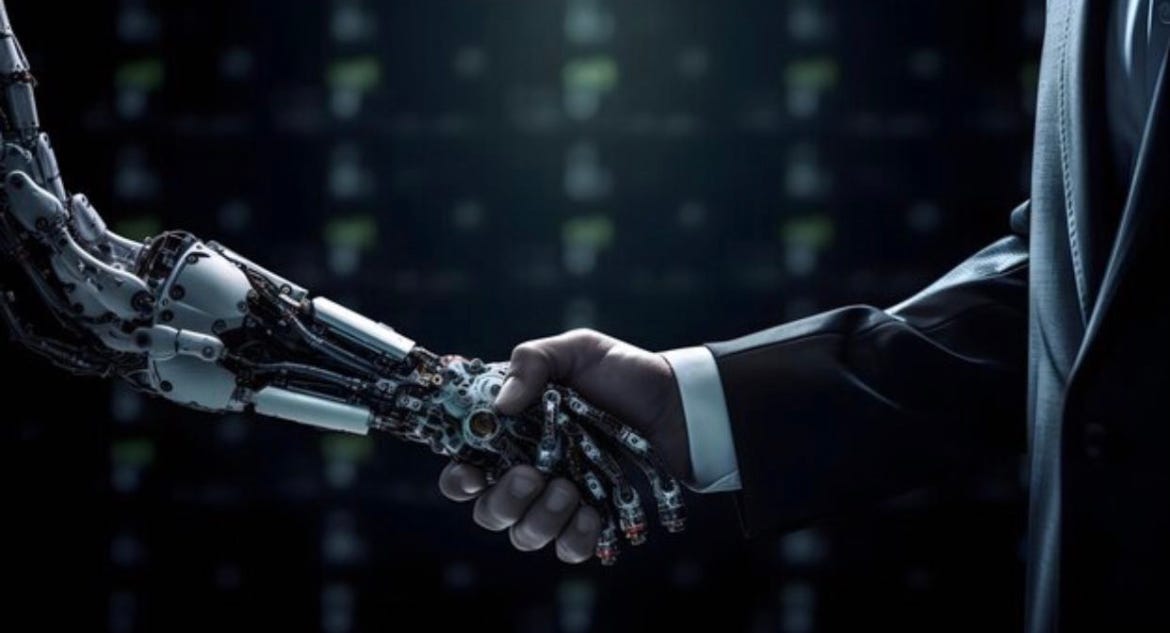
Rather than seeing AI as a rival to traders, it’s more realistic to view this relationship as a complementary coexistence. Traders can use AI to obtain in-depth information and analysis, while bringing in their human expertise to interpret this data in a wider context.
Artificial intelligence is driving radical change in the world of traders, but that doesn’t mean the end of the human role. Traders must evolve to become players of the digital age leveraging AI to increase efficiency and accuracy. As we navigate this ever changing financial landscape, intelligent collaboration between man and machine could well be the key to a prosperous future for traders.
The increasing integration of AI in the financial sector also requires the acquisition of new skills. Traders need to understand how to interact with AI systems, interpret their results and adjust their strategies accordingly. Mastering technological tools is becoming as important as traditional market knowledge.
The incorporation of artificial intelligence into the world of finance has been one of the most remarkable developments of recent decades.
Sophisticated Algorithms and Machine Learning capabilities have enabled AI systems to process complex financial data at unprecedented speed and accuracy. The automation of transactions and the detections of hidden patterns in markets are now managed by machines endowed with unprecedented computing power.
Now, let’s be honest… NO artificial intelligence won’t 100% replace a trader.
Let’s say it will serve as a tool in addition to his skills, furthermore, one of the major risks associated with the use of AI in trading is increased market volatility. AI systems can overreact to market fluctuations, amplifying price movement and contributing to the formation of speculative bubbles. When these bubbles burst, they can trigger major financial crisis with potentially devastating consequences for investors and the economy as a whole.
AI can be vulnerable to errors and biases in the data it is trained on. If AI models are trained on historical data sets that contain unusual periods or exceptional events, they risk making inappropriate decisions in similar situations in the future.
AI Black-Box Problem
Another major problem is the AI ‘Black-box’ the decisions made by AI models can be extremely complex and difficult to explain this creates a lack of transparency and accountability as it becomes difficult to understand how and why specific trading decision was made. In the event of an error or problem it can be difficult to determine the cause and make appropriate corrections, so I’ll say it again. Artificial Intelligence won’t totally replace the trader of today and even less the trader of tomorrow, because it would already be far to complex, but also because there are far too many risks involved. And I don’t need to remind you that as traders, your risk management has t be the best possible. So imagine this for banks or investment funds.
One last example
We can take one last example of how advanced artificial intelligence is in trading, and that’s Bloomberg GPT. The financial industry in constantly evolving and with the advent of technology, new opportunities and challenges have emerged. In this context, Bloomberg GPT (Generative Pre-Trained Transformers) stands out as a revolutionary tool designed to facilitate traders work rather than replace it.
Bloomberg GPT primary objective is to help traders navigate the constant stream of financial data, news and economic events that can influence the markets. Thanks to its ability to analyse huge quantities of information quickly and efficiently, it can provide customised summaries, contextual insights and predictions based on historical trends.
I hope this newsletter has given you a little more insight into what appears to be a very important topic in the financial sector for the next years.
Let me know your thoughts about A.I. in the comments.